
Veda5 Rishikesh Review: What to Know Before You Book
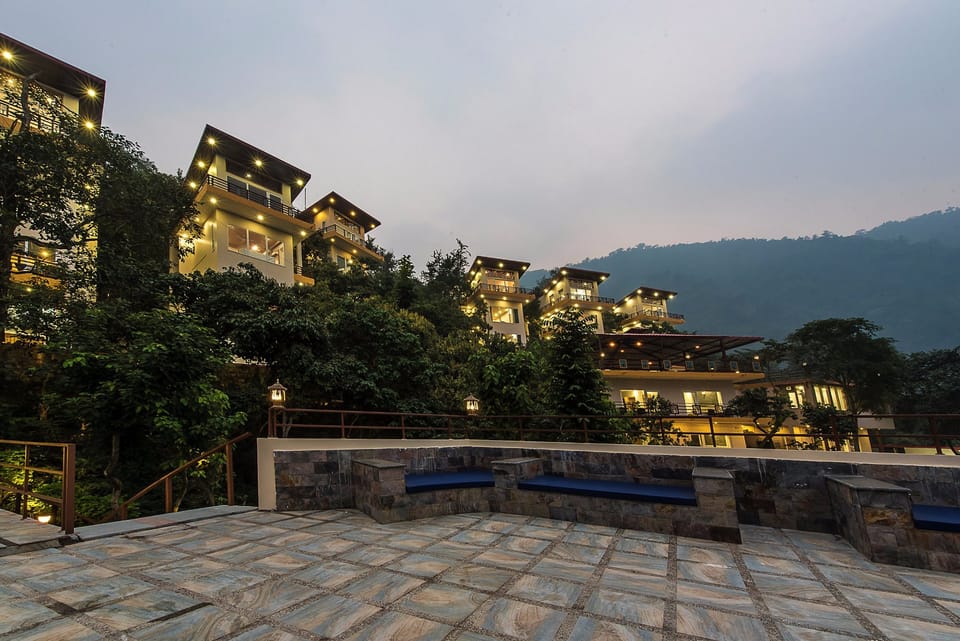
Most people find Veda5 the same way. A search for an Ayurveda retreat in Rishikesh, a website full of mountain views and treatment rooms, four packages with Sanskrit names, and then the harder question: is this actually right for me?
We visited. And we have gathered all the information you would want to decide whether to spend two or three weeks and a significant amount of money here.
The single most useful thing we can tell you is this: Veda5 is an Ayurveda retreat and a yoga retreat in roughly equal measure, weighted slightly toward the yoga. Almost every disappointed guest we came across was someone who booked expecting one and received the other.
Timetables tell you everything. A typical day at Veda5 runs something like:
- 6:30 am — wake, and traditional cleansing practices if you want them: tongue scraping, herbal rinses, oil pulling, in the pre-dawn window Ayurveda calls Brahmi Muhurta
- 7:30 am — yoga, one hour, beginners' level
- 8:30 am — breakfast
- 11:30 am — yoga, one hour, intermediate level, usually built around a focus like back bending or hip opening
- 12:30 pm — lunch, followed by Yog Nidra, restorative practice
- 2:30 pm — your Ayurvedic treatment
- 4:00 pm — an activity block: cooking class, lecture, dance, film
- 5:45 pm — meditation, one hour
- 7:00 pm — evening Aarti
- 7:30 pm — dinner
Count the practices. Three or four sessions of yoga and meditation. One treatment.
That single therapy runs 75 to 90 minutes, which is a proper classical length, long enough for preparation, the treatment itself, and rest afterwards, rather than the compressed 45-minute slot that lets a property advertise more sessions while delivering less of each. But it is one session, and the rest of the day belongs to practice, rest and the valley.
If you are coming to rebuild a yoga practice inside a supportive Ayurvedic framework, this is close to an ideal structure. If you are coming with a condition and want the maximum therapeutic load your body can take, this is lighter than a dedicated treatment hospital would give you.
The treatment side is more serious than the schedule suggests
One session a day is not the same as a light-touch operation, and it would be wrong to leave that impression.
Veda5 delivers the full five-stage Panchakarma protocol; Vamana, Virechana, Basti, Nasya and Raktamokshana. Panchakarma means five actions, but most properties advertising it deliver two or three, usually Virechana and Basti. Vamana and Raktamokshana are the stages that require genuine clinical confidence and the willingness to turn away unsuitable candidates. A retreat offering all five is making a substantive claim about how it practises.
The Ayurveda centre holds seven treatment rooms, all configured for four-hand therapy where the protocol calls for two therapists working in synchrony. For a property of 24 rooms, that is generous capacity, it means treatment slots have flexibility in them rather than being rationed, and four-hand therapy is genuinely available rather than theoretical.
Your stay opens with a consultation with a senior Ayurvedic physician: a written intake, pulse reading, and assessment of where your doshas are presenting out of balance, physically and mentally. From that the doctor sets both your treatment schedule and your diet together, in the same consultation, which is the correct order and not universal. You are then issued cotton treatment clothing, a shirt and pyjama to wear during therapies.
The senior physician, Dr. Shuchita Singh, holds an MD and a PhD in Panchakarma with over fifteen years of practice, specialising in skin conditions and bone and joint disorders.
The yoga is the reason to come
Yoga runs twice daily, split by level, across two yoga pavilions and two halls for 24 rooms is what allows a genuine beginner class and a genuine intermediate class to run rather than one compromise session for everybody. The teaching is therapeutic rather than generic: postures are selected against your constitution and the imbalance you presented with, so the class is shaped by the same assessment that set your treatment.
Meditation is taught with real range; Chakra practice, Trataka, Transcendental technique, mantra chanting and can be practised in the pavilions, in dedicated meditation huts, or in the property's natural meditation cave, which guests can use alone and in silence for as long as they like.
Beyond the formal programme there is a music room with drums, harmonium, guitar and sound bowls free for guests to use, a library, a swimming pool looking over the valley, a hill trail behind the property, and afternoon activity blocks.
Accessibility
One practical point that changes decisions for some people: the property is built into a hillside across terraced levels, reception at the bottom, then the restaurant, then the pool and Ayurveda centre, then the room blocks above. There is no lift. Moving between your room, your treatment and your meals means stairs and sloping outdoor ground several times a day. For a guest who moves easily this is pleasant; every level looks over the valley. For anyone with a knee, hip or mobility limitation, it is a serious consideration and worth raising with us before you book.
Getting there: Jolly Grant Airport at Dehradun is 31 km away but about an hour by road, and the transfer is included in the stay and package rather than charged separately.
The food
Pure vegetarian, Sattvic, and cooked without onion or garlic, both omitted in the yogic tradition on the reasoning that they stimulate rather than settle, which is the opposite of what a practice-heavy day is trying to produce.
It is better than that description sounds. Everything is cooked fresh, seasoned to a middle register, and plated with care. Dishes carry nutritional information, chapatis and dosas are made to order, and the desserts are good too, which matters more than it sounds, because most retreats remove sweetness entirely and tend to lose people in week two.
Two systems run alongside each other, and it is worth knowing which you will be on. Guests on general wellness and yoga programmes eat from a wide Sattvic buffet and choose freely. Guests on Panchakarma or weight-management programmes receive a personalised, portion-controlled diet chart set by the physician and cooked to that prescription. On a treatment programme, the food is part of the medicine and the doctor controls it.
Not sure whether it fits your condition?
Our Ayurveda doctor will tell you honestly, including if the answer is no. The consultation is free, and we will ask Veda5 the questions on your behalf that a booking page never answers: which physician will be consulting during your dates, what therapist availability looks like, and whether your specific case is one this retreat is genuinely equipped for.
We visit and assess every property we list. Our full assessment of Veda5, including the details we don't publish here, comes with the consultation.
Frequently asked questions
Does Veda5 Rishikesh offer full Panchakarma?
Yes. Veda5 delivers all five classical stages — Vamana, Virechana, Basti, Nasya and Raktamokshana. Many retreats advertising Panchakarma deliver only two or three, so the full sequence is a meaningful distinction. Programmes involving intensive detox carry a twelve-night minimum stay.
How many treatments do you get each day at Veda5?
One Ayurvedic treatment session per day, running 75 to 90 minutes, alongside two to three yoga and meditation sessions. This is a proper classical session length, but a lighter therapeutic load than a dedicated treatment hospital.
How far is Veda5 from Rishikesh?
About 10 km. The retreat is at Ratta Pani on Neelkanth Temple Road, roughly 10 km from Rishikesh town and Laxman Jhula, 6 km from Ram Jhula, and 9 km from the riverside evening Aarti. Everything requires a vehicle.
How do you get to Veda5 Rishikesh?
Jolly Grant Airport, Dehradun is the nearest airport, 31 km away but about an hour by road on hill roads. Airport transfer is included in the stay and wellness package.
Is Veda5 suitable for yoga beginners?
Yes. Classes are split by level across two pavilions, with a beginners' session each morning and an intermediate session later. Newcomers are directed to the appropriate class rather than being placed in the advanced one.
Is Veda5 accessible for guests with limited mobility?
No. The property is terraced across a hillside with no lift, and moving between rooms, treatments and meals involves stairs and sloping outdoor ground several times daily. Guests with knee, hip or mobility limitations should discuss this before booking.
What food is served at Veda5 Rishikesh?
Pure vegetarian Sattvic cuisine, cooked without onion or garlic. Guests on general programmes choose from a buffet; guests on Panchakarma or weight-management programmes receive a physician-prescribed, portion-controlled diet. The property is alcohol-free.
When is the best time to visit Veda5 Rishikesh?
October to March, when the weather is cool and dry and the outdoor parts of the property are fully usable. Peak rates run roughly 20 to 30 per cent above the July-to-September monsoon months.